
In this series of articles, we will look at the different retail concepts that Alibaba launched under its Hema retail brand. We explore how they fared and which ones are still operational. Many of them come with their own fascinating background stories. But overall, the story of Hema’s formats is one of hit and miss…
Note: Alibaba calls Freshippo (yes, with one ‘h’) in English, but in this series, we’ll continue to use Hema because it is easier to differentiate the different concepts using this name.
The story of Alibaba’s Hema brand actually started at Alibaba’s competitor JD.com. A JD employee, Hou Yi, had proposed a rudimentary plan for the Hema concept to JD founder Richard Liu. Hou was hoping to create an offline sales channel for JD, including supermarkets, department stores, speciality stores, cake shops and more. When Hou didn’t get any support for his ambitious plan, he packed his bags and moved to Alibaba, where he started the Hema project and became its CEO. [1] Since then, Hema has grown into a chain of more than 400 stores in 28 cities. [2] Ironically, JD.com would later launch a Hema clone called 7Fresh. It had 49 stores in 2022…
Considering how the first store opened in 2016, some say that growth is relatively slow by Chinese standards. But given the relatively new asset-heavy industry of brick-and-mortar stores that it embarked upon with Hema, Alibaba has probably been cautious about its investments.
An important reason for Alibaba starting the Hema concept was the sharply rising acquisition costs of online customers for e-commerce platforms due to increasing competition. At the same time, many internet companies had started initiatives in fresh food e-commerce. They were interested in these high-frequency purchases that could be a gateway to e-commerce for other product categories but were struggling to find a feasible business model.
And so, as part of a set of different New Retail initiatives, Alibaba launched …
Hema Xiansheng (a.k.a. Hema Fresh, Freshippo)
Hema Xiansheng is, without a doubt, the best-known format of the Hema brand. Most people who have heard of Hema won’t even be aware of other formats. The first Hema Xiansheng store opened in Shanghai in early 2016, and the concept was much publicized in 2016-2018. Some readers will remember the iconic picture of a smiling Jack Ma holding up a king crab at a visit to a Hema store.
Hema Xiansheng was a unique concept when it launched. The only thing I’d seen in Europe that came close to it was an Eataly in Rome, a combination of a supermarket and various restaurants. But Alibaba took this concept much further and developed a supermarket with the following features, all facilitated by a special Hema app: [3]
- Buying groceries in an offline supermarket.
- Order products on the spot in the app and have them delivered to your home later.
- Choosing and having fresh products (mainly seafood) prepared for consumption in the store. In many Hema stores, a large part of the space is dedicated to catering. Hema rents out these food stalls and charges the operators a 20% commission.
- Ordering online and having it delivered within 30 minutes. Hema makes home deliveries within a radius of 3 kilometres around the store. Nowadays, about 60% of all Hema Xiansheng sales are done online.
For those who have visited a Hema Xiansheng, one of the most memorable things is the conveyor belt system below the ceiling. Order pickers with handheld devices place bags with parts of a consumer order in this transport system, which takes the bags from different parts of the store to the warehouse. An order for an individual customer is consolidated there and handed over to the couriers waiting at the back of the store. As such, Alibaba created a store that is also a fulfilment warehouse for online orders. This combination of store and front-end warehouse model has become a standard for many other supermarket chains active in instant retail.
All features at Hema are facilitated by the Hema app, which is, of course, linked to Alibaba’s other apps Alipay (mobile payment) and Taobao (e-commerce). When scanning the barcodes on the products (the store has free Wi-Fi), the consumer is offered elaborate information about the origin of the goods. The app also provides personal recommendations based on the data that Alibaba has gathered about the customer.
In 2018 we created this video about Hema.
In Hema Xiansheng stores, payment at check-out counters must be made using the Hema app. Hema calls itself a ‘membership store’, where membership basically means that you must be a Hema app user. Trying to pay with the Alipay app will not work, although cash payment is sometimes an option at the service desk (but who still carries cash around in China?). By making the app near-mandatory, Hema collects a lot of SKU-level data about its customer. Coupled with all the other data that Alibaba collects on its various platforms and apps and you will understand what makes ‘new retail’ so interesting for Alibaba.
But this also works the other way around. Hema can use Alibaba’s big data capabilities and information on the number of residents, age groups, past purchase amounts, and the surrounding businesses and residences to determine whether the potential customer count for a new Hema location meets the requirements. Hema Xiansheng stores are primarily located in areas with a high concentration of residential communities. [4] Alibaba could also use its large Taobao and Tmall customer base to kickstart a Hema business.
More so than in other supermarket chains, Hema focuses on fresh food products, with seafood, meat & poultry, and vegetables making up over 30% of its total product categories. The freshness of products is emphasized by packaging some products with a clean number that represents the day of the week. [4] In 2018, Hema got caught up in a scandal when staff at a Hema store were seen repackaging products in bags bearing the next day’s number. Hou Yi apologized, saying that the general manager in the store had been fired and the most severe punishments would be delivered to anyone who violated the regulations in the future. [5]
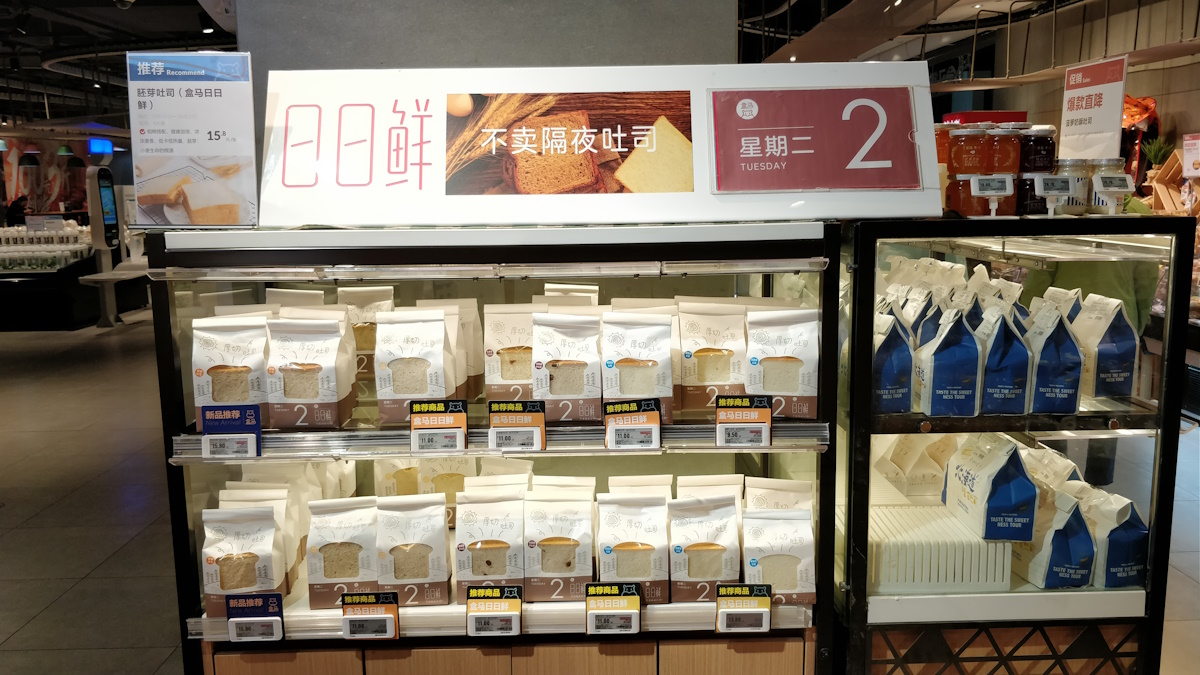
Tuesday’s bread at Hema.
The price levels at Hema are higher than in other supermarkets, which it justifies with superior quality. Hema Xiansheng targets at affluent citizens born in the 80s and 90s. About 70% of its customers are 25-38 years old. ‘He Qu Fang’ (盒区房) has become a common term for the house within the coverage area of Hema distribution and has almost become a status symbol in China. According to 2019 research, houses in these areas sold seven days faster than houses that are not in these areas. [6]
Profitability
With Hema Xiansheng, Alibaba found a way to attract online customers with an offline store. It first lured the curious but naturally suspicious Chinese consumers to the store with seafood catering and then convinced them with the product quality and reassuring information in the app. Many customers would eventually migrate to ordering some or all their groceries from home in the Hema app. And it’s especially these cross-channel customers who buy both online and offline that are the most valuable.
In 2018, the average order value of an online customer was RMB 75 and an offline customer RMB 113. Customers that only buy online spend RMB 279 per month, and those that only buy offline RMB 228. But customers that bought both online and offline spent RMB 575 per month. Each store serves about 156,000 customers.
After opening a store, online orders can reach 5,000 per day in two or three months. Mature stores saw 60% of their orders coming in online. [7] Hema hoped that eventually, 80%-90% of orders would be placed online, making it clear that physical stores were not the primary goal of Hema. While the store has its role, it mainly serves as a place where the consumer gets to know the brand and product range and then orders frequently online, only visiting the physical store sporadically.
In the early years, Alibaba’s investments in offline stores were not received without scepticism. Still, it claimed that Hema’s revenue per square meter was about 3 to 5 times higher than competitors’ stores. It wasn’t clear though who exactly Alibaba considered a competitor. The figures also said little about Hema’s actual profitability. Alibaba only shared that most individual Hema stores were profitable within 12-18 months of launch and after 60% or more purchases came in online.
When Alibaba made different business divisions responsible for their own profitability in 2021, the Hema brand was one of them. In late 2022, seven years after the brand’s launch, Hema announced its Hema Xiansheng stores were profitable. [8] A few months later, in 2023, Hema claimed the whole Hema brand was profitable. Alibaba has announced that Hema plans to go public in the next 6 to 12 months.
A new growth strategy
Don’t be fooled by the recent news that Hema opened 12 new stores on the same day. With the rising penetration of the brand in first- and second-tier cities, the speed at which new stores were opened slowed down after 2019. That year Hema even started closing some lossmaking stores.
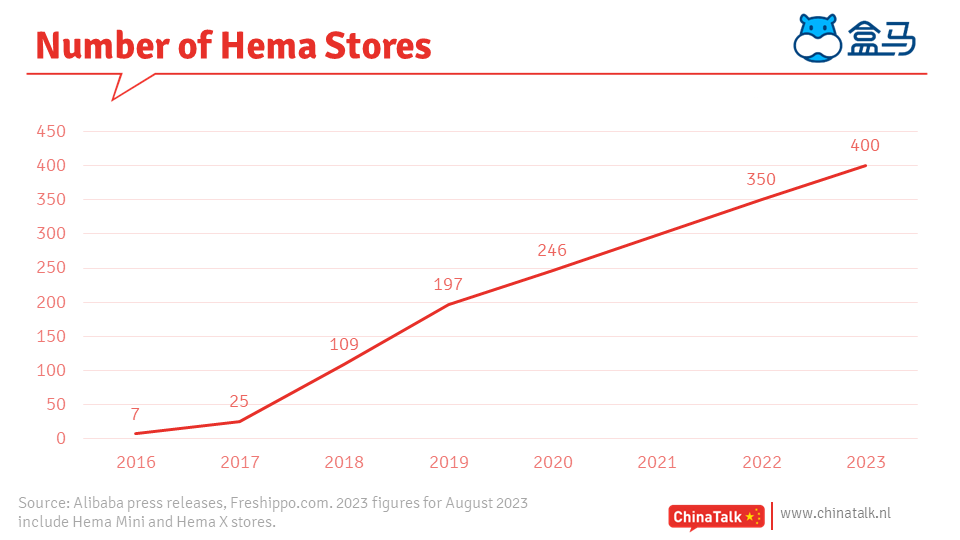
Clearly, Hema needs new growth strategies. One can be found in launching different Hema retail formats (which we will discuss in parts 2 and 3 of this series), and another in enlarging the service area of existing stores.
Recently, Hema Xiansheng started pilots to expand the delivery radius from 3 kilometres in half an hour to 5 kilometres in one hour. Expanding the delivery radius is less costly than opening more Hema Fresh stores in the same city; each store costs about RMB 20-30 million to launch. [9]
Many consumers in this expanded radius are already familiar with Hema. Research showed that 5.4% of Hema’s online orders come from places outside Hema’s service area. [10] If the increase in the delivery radius pays off, Hema will consider launching new stores in lower-tier cities where a 3 km radius would offer too few customers.
Customers and delivery staff have, however, had mixed reactions to the extended delivery range. Customers have complained about late delivery while couriers worry about the workload and income distribution. Some Hema Xiansheng stores have 50 to 100 delivery staff, but when orders surge due to membership day every Tuesday and Wednesday, there are often cases of late delivery. [11]
Remarkably enough, when Hema first launched, the delivery radius was actually 5 km, but Hema soon scaled it down to 3 km after negative customer feedback. For the 3-5 km range, it now uses extra protective materials for cold/frozen and hot products. It also adjusted the order-picking layout in the stores and optimized distribution planning.
Overambitious
When Hema was launched, Alibaba’s Jack Ma said he foresaw “enormous challenges” in the future for companies that are only active online. Alibaba also suggested that it did not want to open a large number of Hema stores and mainly wanted to use the Hema stores to show other retailers what is possible with data and the integration of online and offline. [3]
Alibaba has indeed rolled out the Hema concept of its conveyor belts and home deliveries to RT-Mart, part of Sun Art Retail, which Alibaba largely owns. But in 2019, Hema also announced that it planned to open 2,000 stores by 2022 and would be present in 200 cities by 2030. [12] At the time of writing, there are about 400 stores in 28 cities [2].
These figures tell us two things. First, if the preference of helping third-party retailers with the Hema technology over self-operation ever existed, it must have been abandoned long ago. In part 2 of this series, we will reveal how a possible reason lies in a failed experiment with RT-Mart. Second, Hema has a history of setting overambitious goals that are hard to deliver. Indeed, as we will see in part 2, the story of Hema’s early years is one of overpromising and underdelivering.
Sources:
[1] 牛刀财经 2023-06-06, [2] Freshippo.com on 2023-08-09, [3] ChinaTalk.nl 2017-11-16, [4] Tech Buzz China 2023-06-09, [5] CGTN 28-11-22, [6] 盐财经, 2023-04-03, [7] Huxiu 2018-09-17, [8] SMCP 2023-01-03, [9] 生鲜榜, 2023-03-29, [10] 36Kr, 2023-04-03, [12] Retailnews 2019-07-26
