

Original photo by Dan Congdon
An earlier version of this opinion piece was published on LinkedIn because of a request for a response to an excellent article by Olivia Plotnick. In this version I have added a few notes in italics and images showing how some of the scenarios I describe have already started to play out.
What has been happening last week is extraordinary. Facing a potential ban on TikTok this month, its users have flocked to the Chinese community platform Xiaohongshu (XHS), which has recently changed its international name from RED to REDnote. [For more information on Xiaohongshu, read this Dutch article I wrote in 2019 or our 2023 report on Tech Buzz China.] The two versions of the app aren’t exactly the same. REDnote misses some of the functionality that XHS has, and the interface is in English. But the content is basically the same as in the XHS app.
Remarkably enough, XHS is not a TikTok replacement. Kwai, the international version of China’s Kuaishou, would be. XHS is more like Lemon8, another international tool (and XHS-clone) by TikTok owner Bytedance. Strangely, the ‘TikTok refugees’ chose the REDnote app, and I’m wondering what triggered it. Was it a random suggestion or a brilliant marketing tactic? It seems though that XHS is overwelmed by the sudden influx of foreigners and is frantically recruiting ‘content moderators’ with English language skills.
I have been spending hours watching the videos of the Americans yesterday. It’s a remarkable experience. On Twitter, I shared 10 things I noticed:
- There are a lot more Americans on XHS than I expected. Of course, the algorithm probably keeps serving them up, but it’s a lot!
- A common American reaction is ‘Everybody is so nice here’, and you see much frustration about ‘why is the US government lying to us?’.
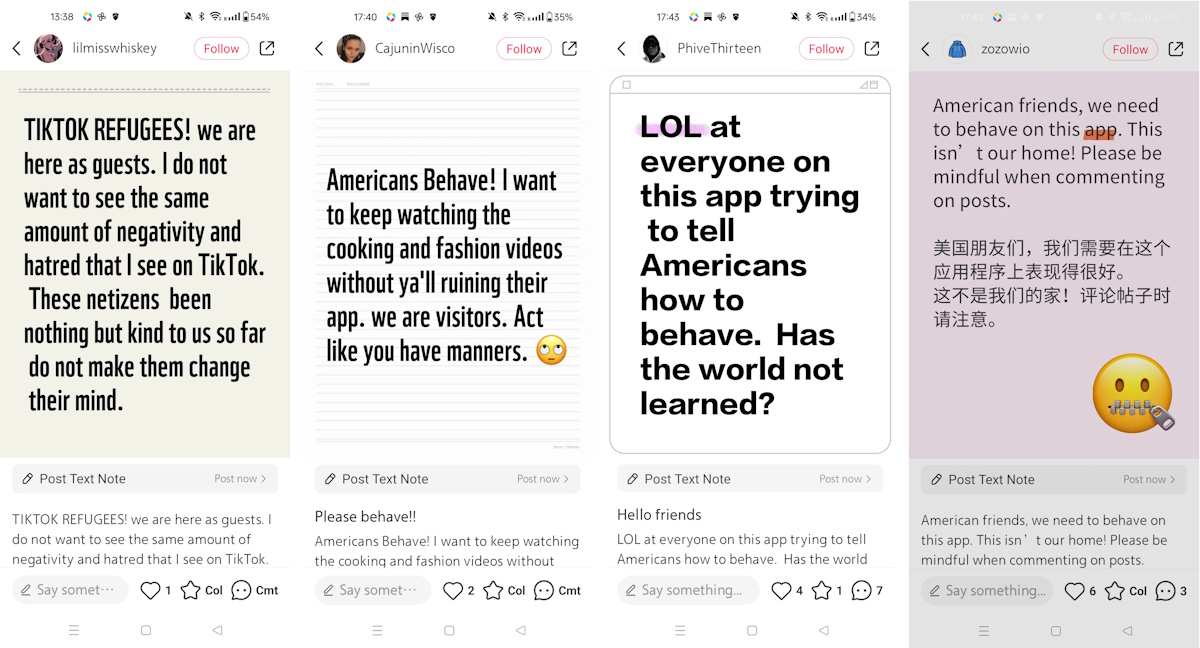
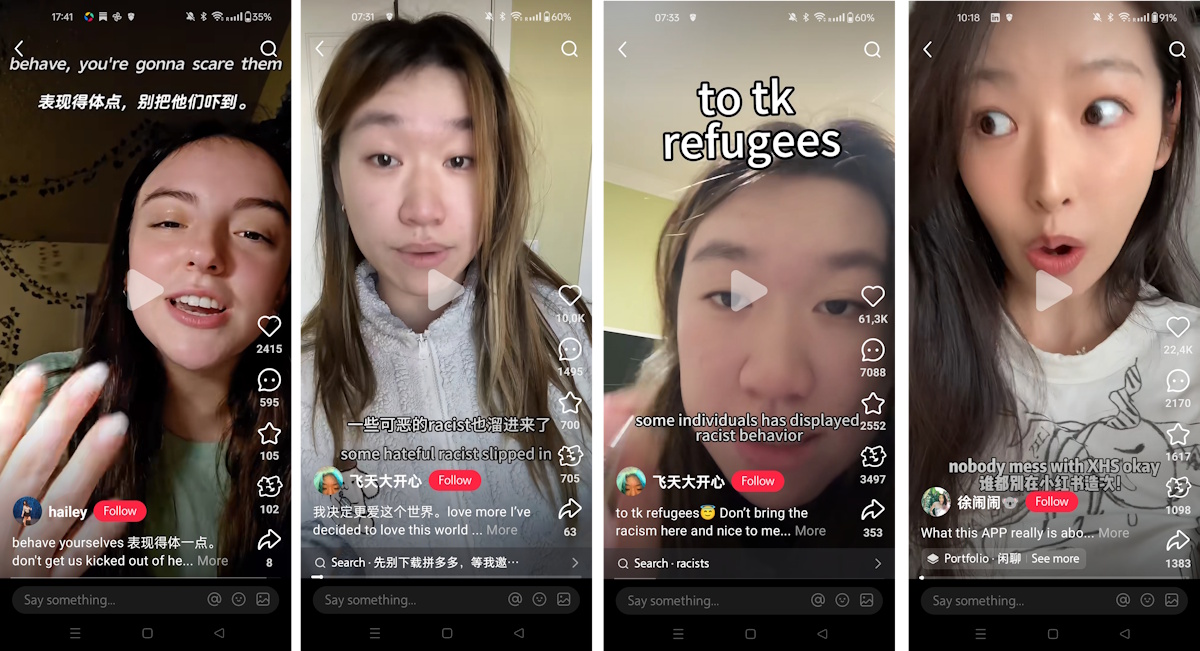
- Many Americans tell their fellow countrymen to be friendly, behave, and act as good guests.
- Some people have seemingly already shown racist behaviours and are being told #3.
- Some people are starting to ask questions like, ‘I really can’t show any skin or talk about LGBTQ here?!’.
- Americans are amused and confused by internet slang (‘666?!’) and different uses of emojis.
- Some people are baffled that their content gets so much more engagement than on the US apps, even when they have hundreds of thousands of users back home.
- Some are surprised that some of their content has already been taken down.
- People seem to want to learn Mandarin all of a sudden.
- Americans are being told they need to add translations.
The willingness of most Americans to adjust to their role of guest on the app and how they say they feel welcomed by the Chinese is heartwarming. Ironically, this digital refugee is something that would never happen in real life, as both the Chinese government and most of the population are not open to harbouring genuine refugees.
All in all, it is a unique thing that is happening, and it fills me with hope that these two cultures could get along if only geopolitics and propaganda got out of the way. Having lived in China, being married into a Chinese family and spending much time there, I know they are mostly amazing people as long as you treat them respectfully.
Still, I’m also a realist, and I can’t see how this cultural exchange will end well in the long run. I want it to continue, but I forsee several scenarios that will derail this fantastic cultural exchange:
Scenario 1: The slow fizzle
XHS takes no corrective action, but the novelty slowly wears off. Americans begin to find the communication process too much of a hassle, and those intending to learn Mandarin realise it’s more difficult than they thought. Others get frustrated because their posts get removed, and they can’t share content about things commonly discussed in the US. Or they post more sensitive things, which then get filtered out for Chinese users, resulting in a lack of engagement.
Other Americans won’t understand that Xiaohongshu is not TikTok but much more an enormous topical user generated content reference guide that has taken the role of a content search engine. Their TikTok-ish content starts to annoy the Chinese, who normally save such content for Douyin (TikTok’s Chinese sister app) and Kuaishou and will find it pollutes XHS.
As more Americans join, the Chinese get tired of constantly explaining how things work on Xiaohongshu. The amount of exchange is decreasing, and both parties lose interest. Besides a happy few, most Americans leave the platform, and XHS returns to its former state, leaving behind a rare moment in time.
Scenario 2: The culture clash
Some people start messing things up for those with good intentions, as often happens on social media. Americans are already posting racial content and being called out to behave by the well-meaning ones.
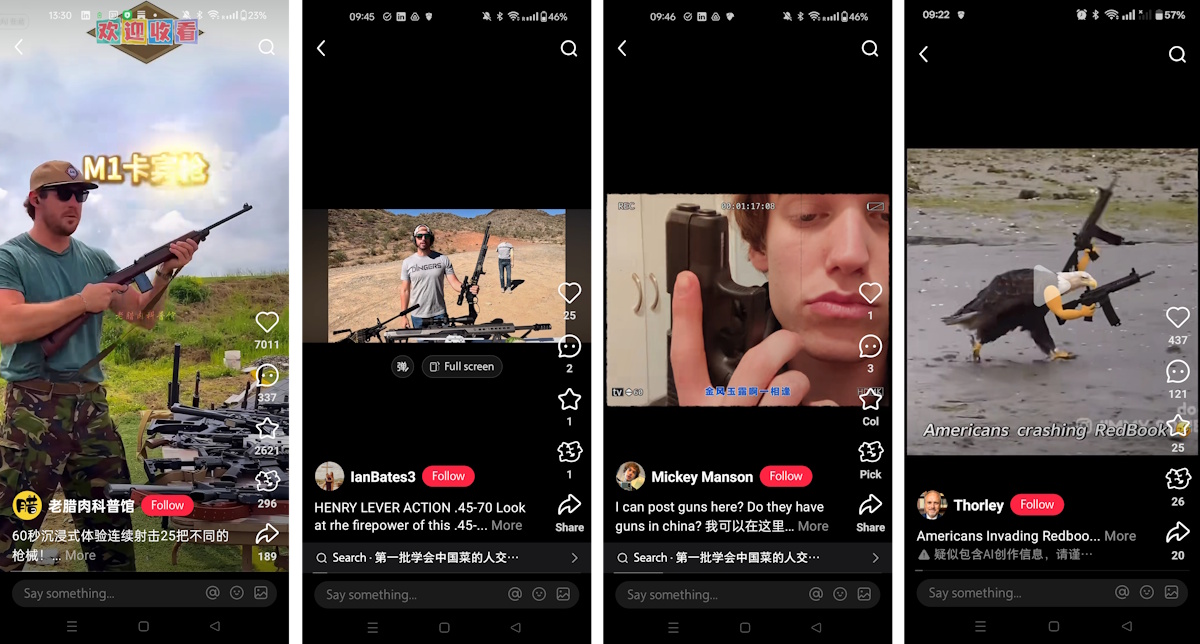
Some have already started showing off their guns on Xiaohongshu, something I can’t imagine the censors being happy about, while it also reinforces prejudices that the Chinese have about the Americans.
Some Americans remind people that ‘xiaohongshu’ means ‘little red book’ in Chinese, and this is a ‘commy propaganda tool’. Such US trolls make the Chinese nationalist ‘little pinks’ come out of the woodwork. Keyboard warriors on both sides are having a field day.
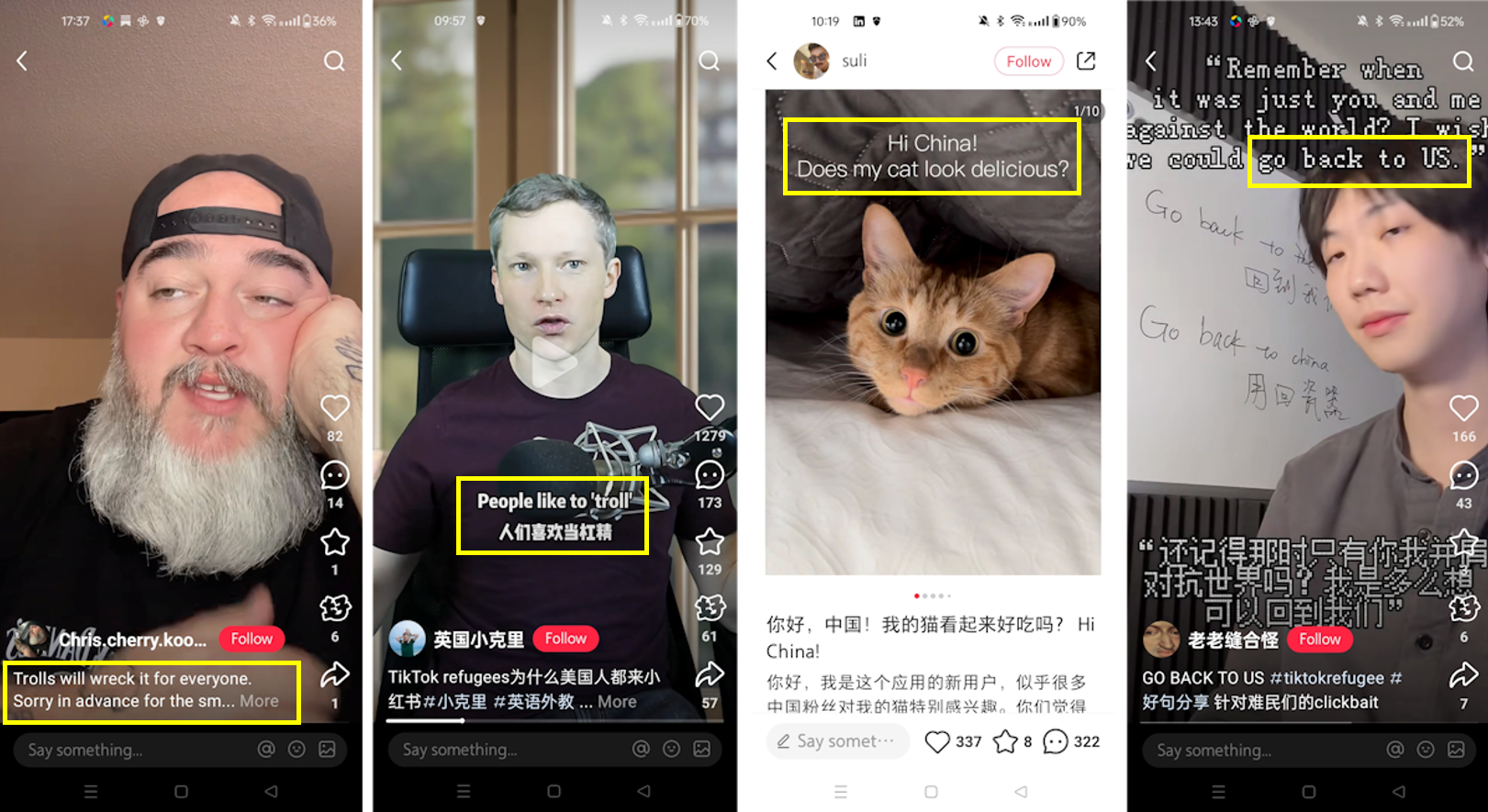
An influx of male Americans could unbalance the friendly, predominantly female community of XHS. Also, people that are used to be outspoken about their sexual orientation get told to tone it down.
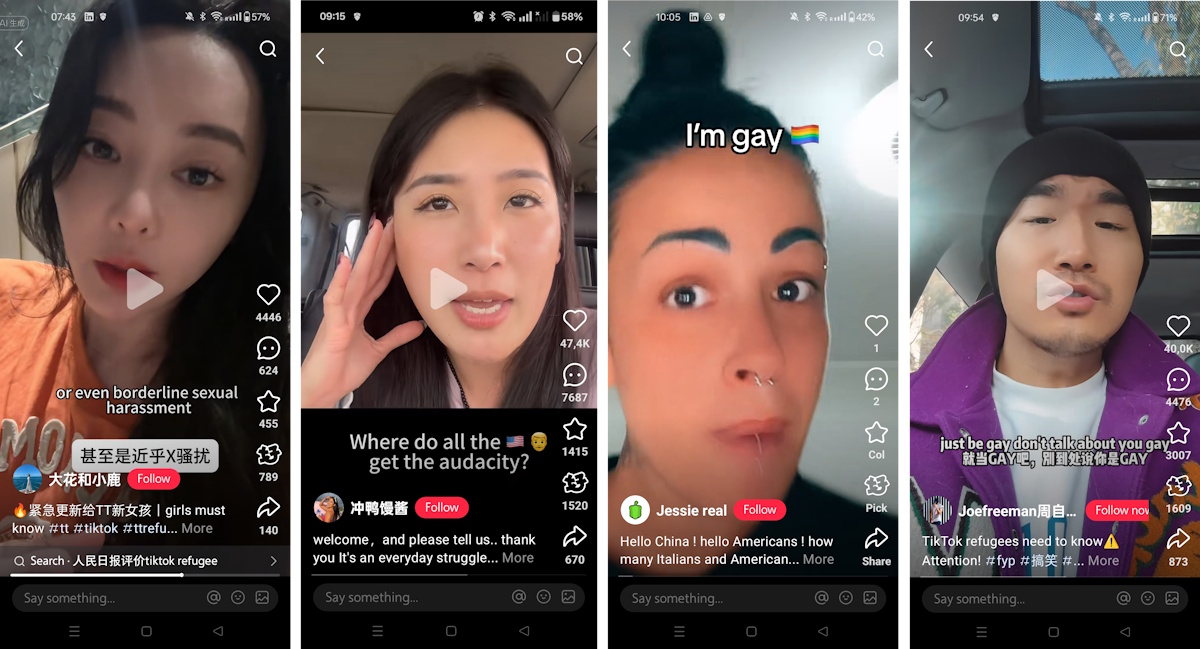
Some Americans will show strange behaviour or entitlement that will start rubbing the Chinese the wrong way. It starts to feel like a digital form of imperialism.
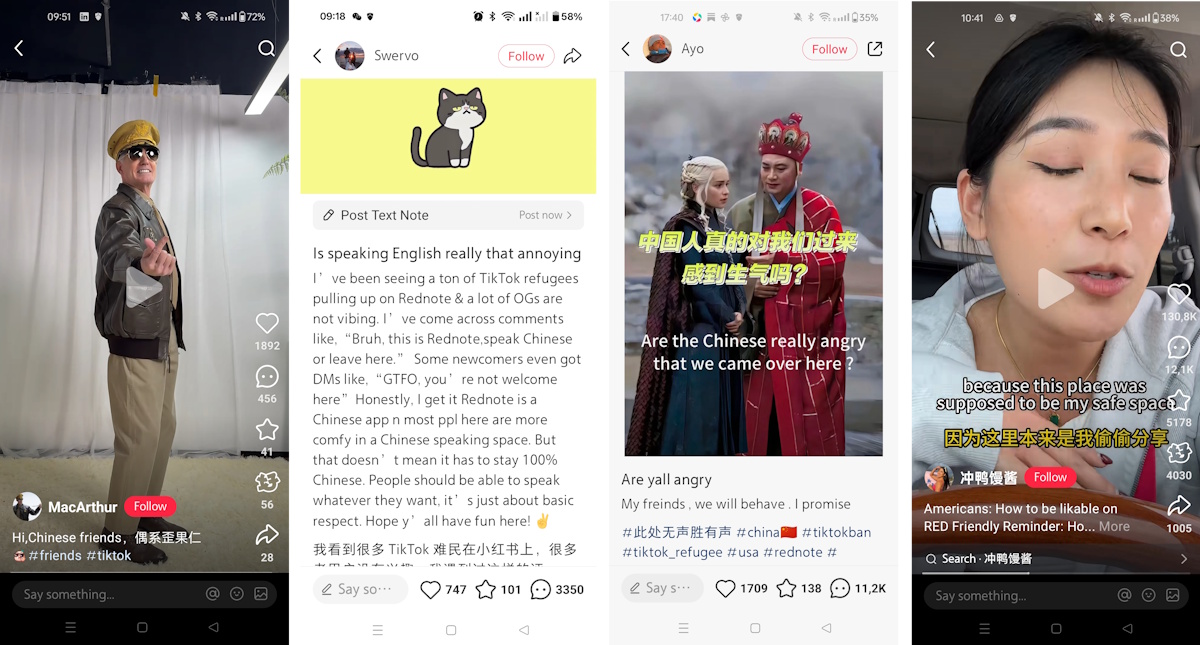
General discontent happens, and XHS will have to intervene by its own initiative or because the government asks them to. They either shut out the Americans or create two different apps, Xiaohongshu and REDnote, in Douyin-TikTok style, effectively separating the two groups.
The Xiaohongshu version won’t be available in the Apple and Google app stores, and REDnote will be blocked in China. REDnote opens up a whole new can of worms and would follow the same political scenario as TikTok, potentially also being banned. The incredible cultural exchange dies.
Scenario 3: Xiaohongshu does a TikTok
Xiaohongshu realises the commercial potential but sees the political risks and decides to separate the app and push it to more foreign users before the aforementioned culture clash even happens. If foreigners like the functionality enough, they might continue to use the app.
Unless it is banned with TikTok, Bytedance starts pushing its own XHS-clone, Lemon8, and might get more users because it has more resources than XHS.
Eventually, the political scenario of TikTok mentioned above happens. Again, the cultural exchange has been killed off.
Scenario 4: Chinese government intervention
The Chinese government favours people-to-people exchange between the US and China. But within China, it has to happen on their terms. They are probably amused that so many Americans are showing discontent with their government, which serves their framing that the grass is not greener on the other side of the hill. That the Chinese are much better off in their own country.
However, the reason why the Americans are so angered also hits very close to home because it is about shutting out popular apps and bullying the population. Chinese that follow this discourse will see the irony in all of this because the Chinese government essentially did the same thing to them 15 years ago when it raised The Great Firewall (not exactly the same, but that’s something for a different discussion).
So, the Chinese government has a dilemma. Does it ask Xiaohongshu to do stricter content moderation? If so, the ‘slow fizzle’ scenario could become a fast fizzle. Or things quickly get out of hand, and the government orders Xiaohongshu to separate the app, resulting in the ‘XHS does a TikTok’ scenario.
Whatever action they might take, they will not allow fully open discussions between the two cultures. Regardless of the way this plays out, the cultural exchange gets killed off for political reasons.
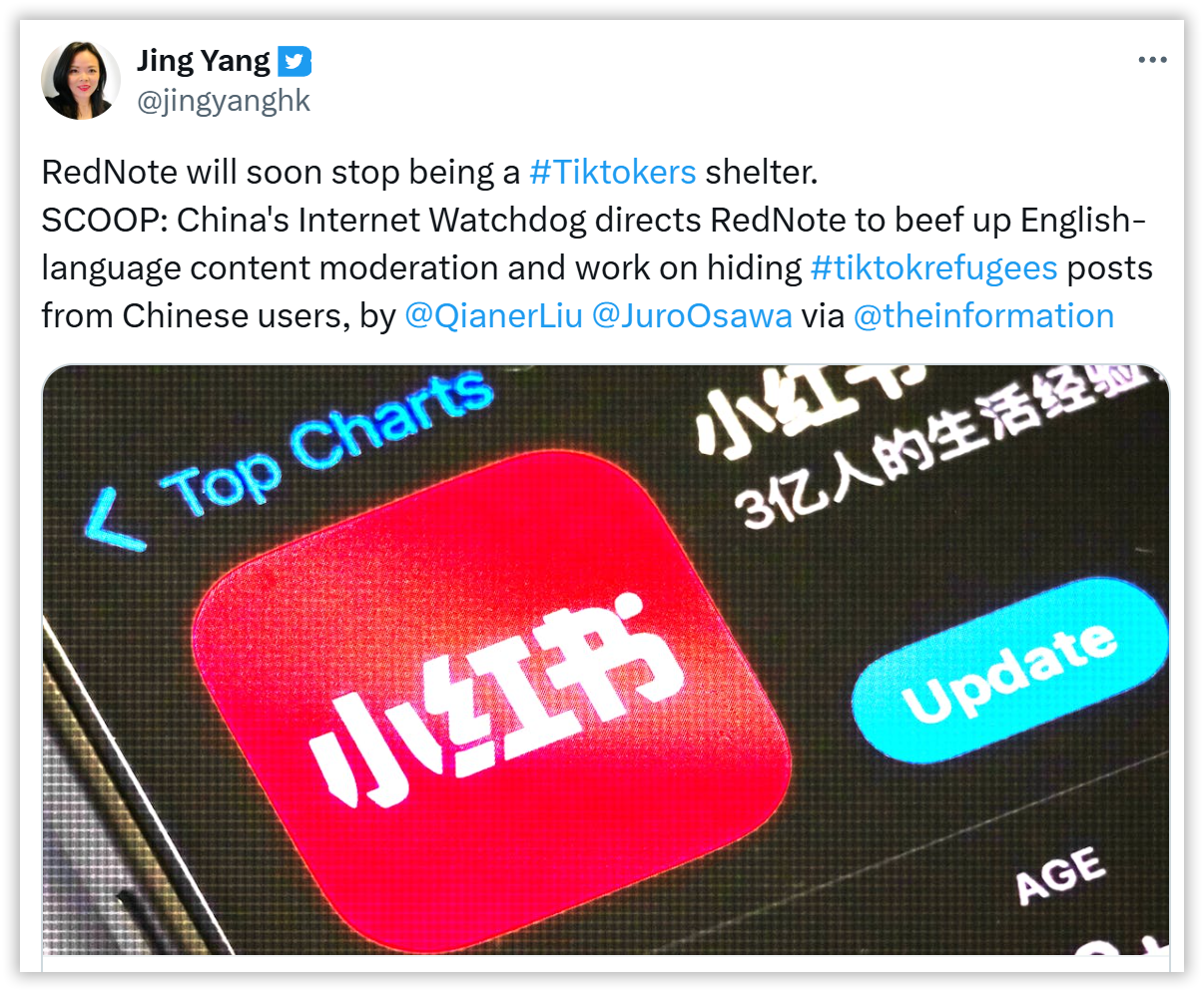
[A day after I wrote this news broke that the Chinese government has instructed XHS to hide Americans from Chinese users.]
Scenario 5: US government intervention
Using the same legislation as for the TikTok ban, the US government will argue that REDnote is just another TikTok in disguise and will ban the app (forced sale is less likely for several reasons). If the numbers (see below) stay relatively low, this might not even happen and they might just let the slow or fast fizzle happen.
Still, because of the existing case law of TikTok, a ban could happen relatively fast, and US companies like Meta will lobby behind the scenes to get it done, all the while happily taking the billions of advertising by Chinese webshops like Temu, AliExpress and Shein. Again, the cultural exchange gets killed off for political reasons.
What about the numbers?
One more thing. While extraordinary, we should not overestimate this movement. I have heard estimations ranging from 10.000 to one million ‘TikTok refugees’. It’s probably closer to the first number, and even if it would be the latter, it’s a fraction of the 170 million US TikTok users. Maybe that number could explode the moment TikTok is banned, but in my view that would only accelerate the five potential scenarios above.
[After the publication of the orginal article, several media outlets have claimed that the number of Americans creating a XHS account has been more than 700.000. Impressive, but still just a fraction of the total US TikTok users.]
I’m really sorry for having to be so pessimistic, and I love to be proven wrong.
One more thing I like to add … Not always so!
After writing the original article above, I’ve spent more time on XHS, watching the cultural exchange unfold.
On the one hand, the people-to-people exchange is terrific. Many Americans show genuine surprise at how friendly people are and how the Chinese differ from what they have been told. There is also extreme frustration about the US government.
Then the questions start. Chinese and Americans ask each other how they live, how much rent they pay, what their healthcare expenses are, etc. For the Americans, this creates a picture that the Chinese are much better off than they are, which only throws extra fuel on the fire of frustration. They see how little groceries cost in China, how nice their homes are, that they have healthcare, that there are no homeless people in China, etc. Americans are left thinking they live in a shithole while the Chinese have it so nice.
But this is a skewed picture.
Specifically on the topic of homelessness, the misperceptions annoy me. Yes, there are far fewer homeless in China, and mostly, they are homeless for very different reasons than those in the US. But it’s not like there are no homeless at all. I used to help a soup kitchen in Xi’an hand out blankets in the cold Xi’an winters. Who were those people? Actors?!
Most users of XHS, especially the ones that speak English well, are well-educated, young, middle-class women (70% of XHS users are female). Many of them have spent time abroad, studying at foreign universities. What you see on XHS is not a good representation of China. It is a relatively well-off sub-group of Chinese citizens mainly living in first and second-tier cities on the east coast.
You won’t see much of the underdeveloped lower-tier cities or rural villages where people have only been recently lifted out of poverty but live a far from glamorous life. These are the people you will find on the Chinese video app Kuaishou. They rarely speak English and often still make ends meet by working the land.
At the same time, there is a bias among the frustrated Americans to share all the things that are bad about their country, while the Chinese do precisely the opposite. They share stunning drone videos of the skylines of Shanghai, Shenzhen, Hangzhou, etc. They post pictures of their beautiful apartments. Americans are gasping for breath when watching beautifully polished footage of China’s fantastic nature. They show low prices and high quality fresh produce in the supermarkets. They share a tsunami of impressive modernity...
And as always, whenever anything is said about China, whether it is the Chinese or foreigners, I just keep repeating one Buddhist mantra in my mind.
‘Not always so …’.
In my ChinaTechTrip study tours, I always start the first day with a masterclass in painting a realistic picture of China. I show the image below and tell participants that there are two sides to China.

I also show how Peter Hessler quoted Scott Fitzgerald in an interview:
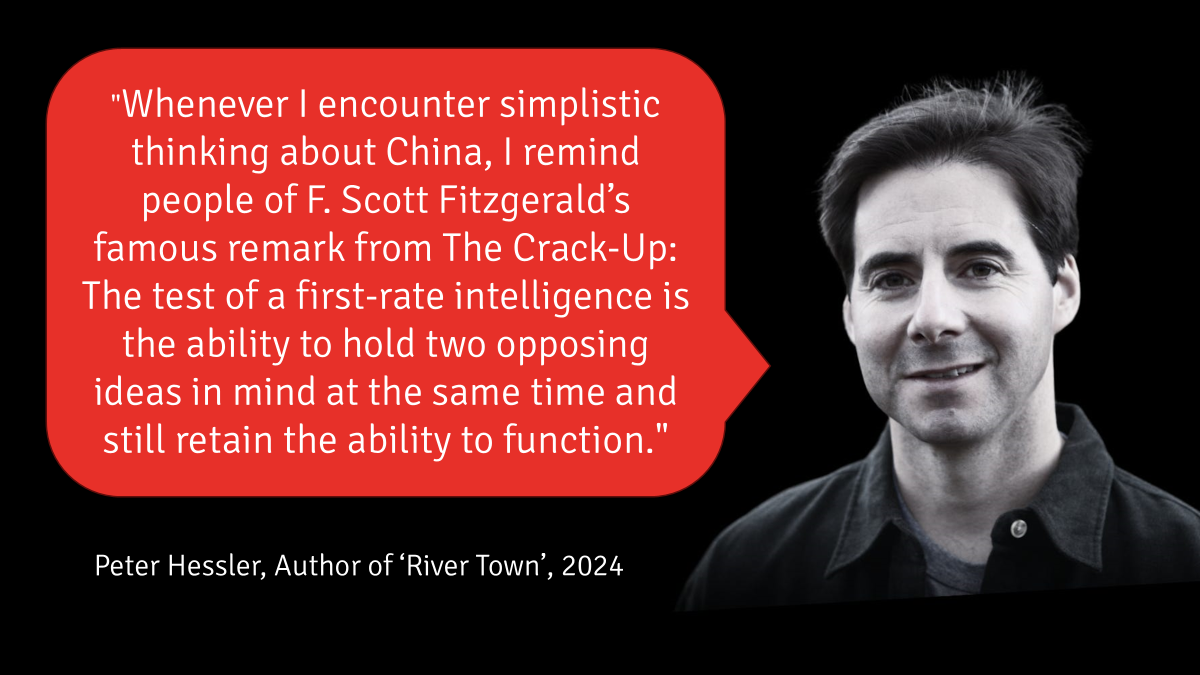
Indeed, this is what China is.
- It is poor rural villages and brightly lit metropolis skylines at the same time.
- It has wide healthcare coverage, but the depth of that coverage is limited, and when you have serious health issues, your extended family often needs to support you financially.
- China has the most advanced apps and internet services but has the most censored internet space.
- The Chinese government aims to improve the people’s livelihood constantly, but it is in exchange for certain freedoms and with high surveillance.
- Many Chinese people are affluent but must work 996, 12 hours a day, six days a week.
- Groceries are cheap, but the average income in China is less than $750.
China is all of these things at the same time.
Whenever you see, hear or read anything about China, always think …
‘Not always so …’.
Just as having a biased negative perception of China is harmful, so is a biased, overly optimistic image of China. You risk underestimating some of the good things you have at home. The grass isn’t necessarily (always) greener on the other side of the Atlantic.
Judging China based on the videos that XHS users show you is just as out of touch as judging it based on the rhetoric of political China hawks.
Stay realistic, stay critical.